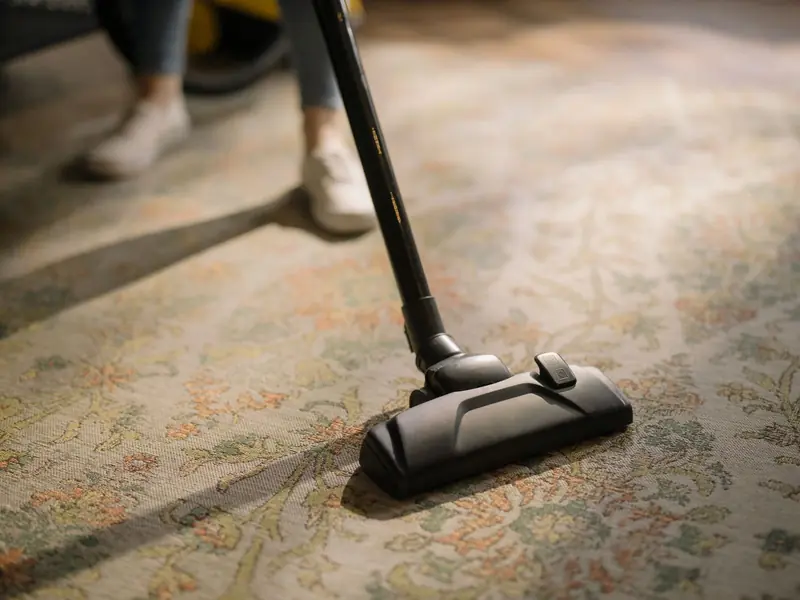

Office carpet takes a beating that nobody notices until the furniture is moved. Grit walks in on shoes and grinds into the pile along the same routes every day, so the fibres in front of the lift go grey while the carpet under the desks keeps its colour. Cleaning it properly means wet cleaning, and wet cleaning means planning around the people who need to walk on it the next morning.
What hot water extraction is
Hot water extraction is the method used for most commercial carpet. Olivers works with Prochem machines, and the process runs in four steps.
- Pre-spray: a cleaning solution is applied across the carpet and left for a short dwell time so that it can loosen soil bound to the fibres.
- Agitation: the pre-spray is worked into the pile with a brush or rotary machine. This is the step most often skipped when work is rushed, and it is the one that makes the difference on heavily used carpet.
- Rinse: hot water is forced into the pile under pressure, lifting the loosened soil and the cleaning solution out of the fibres.
- Extraction: a powerful vacuum in the same wand draws the water and dirt back out into the machine’s recovery tank.
The result is carpet that is clean through the pile rather than only on the surface, with the cleaning agent rinsed out rather than left behind to attract new dirt.
Why the work is done out of hours
Extraction leaves the carpet damp. Walking across it while it dries flattens the pile, tracks new soil onto it, and is a slip hazard on any hard floor that borders it. The machines are also noisy, and hoses run along corridors, which is awkward with people about.
For those reasons commercial carpet cleaning is scheduled for evenings, weekends or overnight, depending on how the building is used. An office that empties at six can be cleaned that evening. A site with a night shift or a weekend trading pattern needs a slot that fits its own quiet period. Olivers arranges carpet programmes around the client’s hours rather than the other way about.
Drying
How long the carpet takes to dry depends on three things: the pile, the heating and the ventilation. A dense wool twist holds more water than a low-loop nylon tile, and takes longer to release it. A room with the heating on and a window that opens dries faster than a sealed floor with the air handling switched off for the night. Where possible the heating is left running and air is moved through the space after cleaning, and the operator adjusts the amount of water to the carpet type.
No fixed drying time can be promised in advance, because it varies from building to building and from one season to the next. What can be arranged is a slot that gives the carpet the longest possible stretch before the first person arrives, which is why Friday evenings and Saturdays are popular for large areas.
Traffic lanes and entrance matting
Not every part of a carpet needs the same attention. Traffic lanes, the routes from the door to the desks and from the desks to the kitchen and toilets, carry most of the soil. A sensible programme cleans the whole floor less often and the traffic lanes more often, which keeps the appearance even and spreads the cost.
Entrance matting protects the carpet behind it, but only while it is clean. Matting saturated with grit stops trapping anything and starts shedding it. Mats should be vacuumed daily as part of the routine clean and extracted along with the carpet.
Spot treatment
Coffee, ink, chewing gum and the occasional mystery mark do not wait for the periodic clean. Spot treatment between full cleans deals with individual stains using the appropriate product for the stain and the fibre. Some marks respond to a solvent, some to an acid or alkaline rinse, and gum is chilled and lifted. Guessing with a supermarket product often sets the stain, and can leave a pale patch that is harder to hide than the original mark. Olivers provides professional stain removal alongside the extraction work.
How a quote is built
A carpet cleaning quote starts with a site survey. The surveyor measures the floor area to be cleaned, notes the carpet type and condition, identifies the traffic lanes and any stains that need separate attention, and asks about access: what time the building empties, where the machine can be parked, whether there is a lift, where water can be drawn and emptied.
From those notes the work is priced on the area, the condition and the access, and the frequency if a programme is wanted rather than a single visit. A quarterly traffic-lane clean with a full extraction twice a year is a common pattern, but the right programme depends on the building.
The carpet cleaning page describes the survey, the equipment and how a programme is scheduled around the working day.